 White Lab Diamond Rings
 Blue Lab Diamond Rings
 Pink Lab Diamond Rings
 Yellow Lab Diamond Rings

 Round Lab Diamond Engagement Rings
 Oval Lab Diamond Engagement Rings
 Pear Lab Diamond Engagement Rings
 Cushion Lab Diamond Engagement Rings
 Emerald Lab Diamond Engagement Rings
 Radiant Lab Diamond Engagement Rings
 Heart Lab Diamond Engagement Rings
 Marquise Lab Diamond Engagement Rings
 What are Lab-Grown Diamonds ?
 Lab-Grown vs. Natural Diamonds
 CVD vs. HPHT
 What are the 4Cs?
 How to read a diamond certificate ?
 Fancy Color Grading
 Ring Sizes
 Pendant Lengths
 Bracelet Sizes
 Metals Guide: 14k or 18k Gold?
Lab-Grown Diamond Tennis Bracelets: A Complete Buying Guide
From a single line of brilliance worn on a tennis court in 1987 to one of the most coveted pieces in fine jewelry: the tennis bracelet has earned its place. Here is everything you need to know before buying one.
The Story Behind the Tennis Bracelet
The tennis bracelet did not start in a jewelry atelier. It began on a court. In 1987, during the US Open, professional tennis player Chris Evert lost her delicate diamond line bracelet mid-match. She asked the officials to pause the game until it was found. The style she was wearing already had a name, an in-line diamond bracelet, but that moment gave it a new one. The name has stuck ever since.
Before that moment, in-line diamond bracelets had existed for decades. Art Deco jewelers of the 1920s and 1930s were particularly drawn to the format: a continuous line of identically set stones, clean, geometric, uninterrupted. The style reflected the era's obsession with symmetry and precision. It moved comfortably from formal evening wear to everyday elegance.
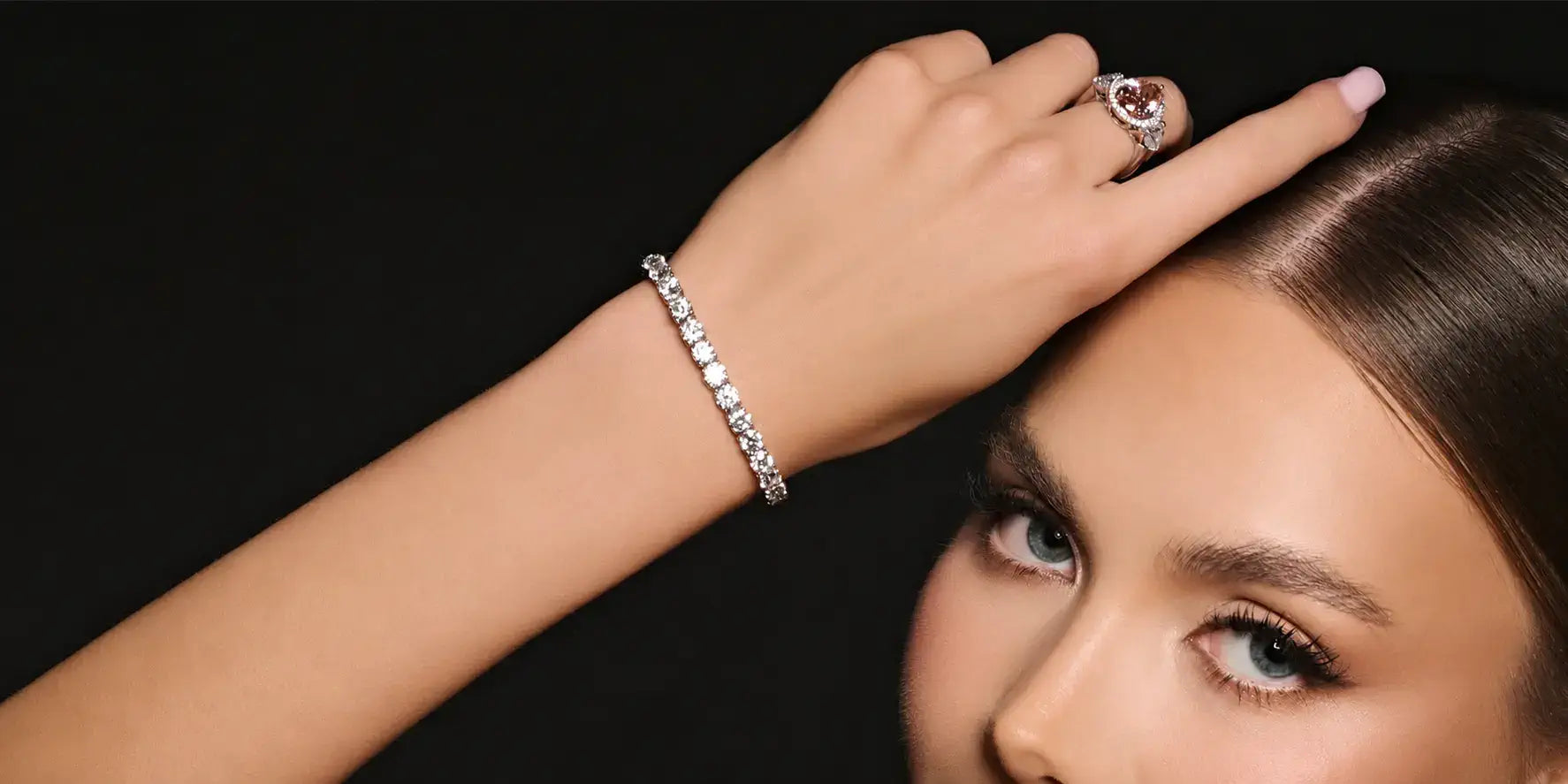
A single continuous line of identical diamonds — no beginning, no end. The tennis bracelet is one of the few jewelry formats that is simultaneously minimal and maximalist.
Through the 1980s and 1990s, the bracelet became a staple of fine jewelry: aspirational, versatile, and universally flattering. Today, it sits at the intersection of classic and contemporary. Worn alone, it is understated. Stacked, it becomes a statement. Lab-grown diamonds have made the format newly accessible without compromising on what makes it exceptional, continuous brilliance.
Shop our lab diamond bracelets ➤
Stones & Carat Weight: What Should You Look For in a Tennis Bracelet?
The total carat weight of a tennis bracelet refers to the combined weight of all stones across the entire piece, not a single stone. Understanding this distinction is essential when comparing bracelets.
TOTAL CARAT WEIGHT: WHAT IT MEANS
|
EVERYDAY ELEGANCE: |
STATEMENT: |
EXCEPTIONAL PRESENCE: |
ULTRA-LUXURY: |
|
Stone size: |
Stone size: |
Stone size: |
Stone size: |
|
The most worn range. Strong visual presence while remaining wearable across occasions. |
High-visibility. Designed to be seen. Exceptional light performance on the wrist. |
Each stone commands individual attention. Maximum brilliance and presence on the wrist. Reserved for clients who want the bracelet to be the centerpiece. |
Exceptional individual stone size. Each lab-grown diamond carries significant weight and light performance on its own. Rare, investment-grade pieces. Bespoke by nature. |
The table above is based on a standard 18cm bracelet length and shows the stone size range for each total carat weight.

Shop our 17.65ct Round Lab Diamonds Tennis Bracelet ➤
INDIVIDUAL STONE SIZE
A bracelet set with fewer, larger stones looks very different from one set with more stones of a smaller size. Fewer stones create a bolder, more defined line. Each diamond is individually visible and commands its own presence. More stones of a smaller size create a softer, more continuous shimmer across the wrist. Both are valid aesthetics. The choice depends on your preference for bold presence or understated elegance.
Total carat weight is also directly tied to the length of the bracelet. A 15cm bracelet and an 18cm bracelet set with the same stone size will not carry the same total weight. The longer piece holds more stones and therefore accumulates more carats. When comparing bracelets, length and stone size must always be read together.
At BÄL, every stone is hand-selected by our diamantaires for cut precision, color consistency, and visual performance. A bracelet is only as strong as its weakest stone, which is why uniformity across every setting is non-negotiable.
COLORED DIAMONDS IN TENNIS BRACELETS
While white diamond tennis bracelets remain the most requested, yellow, pink, and blue lab-grown diamonds offer striking alternatives. Colored bracelets are graded by intensity: Fancy Light, Fancy, Fancy Intense, and Fancy Vivid. A Fancy Intense yellow bracelet worn in sunlight is genuinely difficult to ignore. For colored stones, uniformity of tone across all stones is the most critical selection criterion, and the most difficult to achieve.
Why Choose a Lab-Grown Diamond Tennis Bracelet?
Lab-grown diamonds are not simulants. They are not cubic zirconia or moissanite. They are real diamonds: chemically, optically, and physically identical to mined stones, grown in controlled conditions using the same crystalline structure that forms underground over billions of years.
For a lab diamond tennis bracelet specifically, the case for lab-grown is particularly strong. A piece that requires 30, 40, or 50 matched stones of consistent quality is extraordinarily difficult to source from mines at scale. Lab-grown production makes consistent, high-quality matching across every stone significantly more achievable, and at a price point that reflects that.
LAB-GROWN VS. NATURAL DIAMONDS: HOW DO THEY COMPARE?
This is one of the most common questions we receive, and the answer is more straightforward than many expect. The differences are not in appearance or durability, but in origin and price.
|
LAB-GROWN DIAMOND |
NATURAL (MINED) DIAMOND |
THE REALITY |
|
|
Chemical composition |
100% carbon, identical to mined |
100% carbon |
IDENTICAL |
|
Hardness (Mohs scale) |
10, the hardest natural material |
10, the hardest natural material |
IDENTICAL |
|
Optical properties |
Identical brilliance, fire & scintillation |
Identical brilliance, fire & scintillation |
IDENTICAL |
|
Certification |
IGI, GIA certified, graded by the same 4Cs |
IGI, GIA certified |
IDENTICAL |
|
Price point |
A fraction of the price of an equivalent mined diamond, for the exact same physical and optical properties |
Significantly higher for equivalent quality |
WHERE IT DIFFERS |
|
Traceability |
Full production transparency, no conflict sourcing |
Varies by supply chain |
WHERE IT DIFFERS |
Read our Complete Guide for Lab-Grown vs Natural Diamonds.
HOW MUCH DOES A LAB DIAMOND TENNIS BRACELET COST?
Budget is one of the first and most important considerations when purchasing a tennis bracelet, and lab-grown diamonds make the equation significantly more favorable. At BÄL, every piece is calibrated with the same priority: cut, consistency, and construction above all else. Price is determined by three variables: total carat weight, individual stone size, and bracelet length. Longer bracelets require more gold, which directly increases the overall cost alongside the additional diamond weight. For the equivalent quality in natural mined diamonds, expect to pay more for the same visual result. Lab-grown allows you to invest in a larger total carat weight, a higher color grade, or a better-quality setting, without compromise.
To explore our current pricing and available configurations, check our tennis bracelet collection or book a private appointment at our Dubai showroom.
Metal, Setting & Construction: What Makes a Tennis Bracelet Last?
18K GOLD: THE ONLY OPTION
All BÄL pieces are set in 18k gold, nickel-free. The choice is deliberate. 14k gold introduces more alloy, affecting both color depth and long-term durability. 24k gold is too soft for prong-set stones. 18k is the professional standard for fine jewelry: balanced in composition, durable in wear, and rich in appearance.
Beyond purity, the color of the gold plays an equally important role in the final result. The metal is not simply a setting. It directly influences how the stones read on the wrist. BÄL tennis bracelets are available in three gold colors:

Yellow Gold:
Rich, warm, and deeply classic. 18k yellow gold is the most saturated of the three finishes, giving the lab-grown diamond tennis bracelet a bold and confident presence. It creates a cohesive, unified look with warm-toned stones and adds depth and character to cooler ones.

White Gold:
Cool, clean, and effortlessly elegant. 18k white gold keeps the focus on the stones, letting their brilliance and color take center stage. A versatile finish that works beautifully across all lab-grown diamond colors and tennis bracelet styles.

Rose Gold:
Warm, soft, and distinctly modern. 18k rose gold brings a gentle glow to the lab-grown diamond tennis bracelet, creating a look that feels both refined and approachable. It works in harmony with warm-toned stones and adds a flattering contrast to cooler, brighter ones.
SETTING STYLES
Four-prong setting: is the standard and most elegant choice for tennis bracelets. The stone is held by four fine prongs, maximizing the exposed surface and allowing maximum light to enter from every angle. The result is clean, structured, and high-performance.
Bezel setting: surrounds each stone with a continuous metal rim. It is more protective and gives the bracelet a sleeker, more architectural appearance.
Mounting proportions matter enormously.
At BÄL, shank thickness, prong dimensions, and overall construction weight are calibrated so the bracelet sits correctly on the wrist, moves fluidly, and photographs with clean lines. This level of engineering detail is not standard across all ateliers.
CLASP SECURITY: A CRITICAL FACTOR FOR EVERYDAY WEAR

Clasp security is one of the most important, and frequently overlooked, considerations when purchasing a tennis bracelet. A poorly designed clasp is the single most common reason bracelets are lost or returned for repair.
At BÄL, every tennis bracelet features a double-lock box clasp as standard. This mechanism requires a deliberate two-step action to open, meaning the bracelet cannot accidentally come undone during daily wear, exercise, or travel. This is the same clasp standard used by the world's leading fine jewelry houses.
What to look for in clasp quality:
-
Box clasp with double safety lock: the gold standard for tennis bracelets
-
Clasp width should match the bracelet width. A mismatched clasp creates weak points
-
Smooth internal mechanism with clear tactile feedback: you should feel the lock engage
-
Clasp made from the same gold alloy as the rest of the bracelet, not plated or mixed metals
If you are buying a tennis bracelet to wear daily, this is not a detail to overlook. At BÄL, we are happy to walk you through our clasp construction in detail during a private appointment.
Sizing Your Tennis Bracelet
Tennis bracelet sizing is measured in length, not diameter. The standard finished length ranges from 16cm to 20cm depending on wrist circumference. The correct fit sits close to the wrist with enough room to move naturally, without restriction, but not loose enough to slide over the hand.
|
WRIST CIRCUMFERENCE |
RECOMMENDED LENGTH |
|
14 – 15 cm |
16 – 17 cm |
|
15 – 16 cm |
17 – 18 cm |
|
16 – 17 cm |
18 – 19 cm |
|
17 cm - 18 cm |
19 – 20 cm |
To measure your wrist, wrap a soft tape measure or a strip of paper around the narrowest point of your wrist, just below the wrist bone. Add approximately 2cm to that measurement for the ideal tennis bracelet length. If you are between sizes, size up: a bracelet that sits slightly longer moves better and wears more comfortably than one that is too tight.
All BÄL tennis bracelets are made to order. Stone size, total carat weight, gold color, setting style, and bracelet length can all be configured for your exact specifications.
Read our Bracelet Length Full Guide.
What Quality Actually Means in a Lab Diamond Tennis Bracelet
When evaluating a tennis bracelet, four elements, collectively known as the 4Cs, determine the quality of every individual stone. At BÄL, our diamantaires assess each one before selection. All lab-grown diamonds above 1.00ct are independently certified by the International Gemological Institute (IGI), one of the world's leading diamond certification laboratories.
Understanding the 4Cs allows you to make an informed decision, and to compare certificates accurately when evaluating any lab-grown diamond tennis bracelet.
|
THE 4CS |
WHAT IT MEANS FOR A TENNIS BRACELET |
|
Cut |
The single most important factor for visual performance. A well-cut stone maximizes light return and creates the brilliance and fire you actually see. Poor cut kills the stone regardless of color or clarity grade. IGI grades Cut on a scale from Excellent to Fair. At BÄL, we select Excellent and Very Good only. |
|
Color |
For white diamonds, color grades D through J are considered colorless to near-colorless. Below J, warmth becomes visible to the naked eye. Consistency across all bracelet stones is more important than absolute grade. IGI color grading ensures every stone is independently assessed. |
|
Clarity |
VVS to VS is the practical range for tennis bracelets. Eye-clean stones in this range are indistinguishable from higher grades in normal viewing conditions. Inclusions that affect visual performance or structural integrity are always rejected. |
|
Carat Weight |
Total carat weight (ctw) represents the sum of all stones in the bracelet. Individual stone size and total carat weight are both listed on the IGI certificate. Understanding the difference is key to comparing value across bracelets. |
For a deeper understanding of how the 4Cs apply to lab-grown diamonds specifically, refer to our Complete 4Cs Guide.

Tennis Brac![]() elet Styles, Diamond Shapes & How to Wear Them
elet Styles, Diamond Shapes & How to Wear Them
The classic single-line tennis bracelet remains the foundational format, and for most clients, the right starting point. But the format has evolved considerably, and the choice of style, diamond shape, and how you wear the piece all contribute to the final result.
BRACELET STYLES
Single-Line:
One continuous row of identically set stones. Clean, precise, and universally flattering. The most versatile jewelry purchase you can make: it works at every occasion from daily wear to formal events.
Double-Line:
Two parallel rows of stones set side by side. More presence, more coverage, a stronger visual statement. Often preferred for statement pieces or as an anniversary upgrade. The BÄL Double-Line is engineered to drape fluidly: the added weight is balanced by a flexible construction that moves naturally on the wrist.
Mixed Shapes:
Alternating stone shapes, round brilliants with emerald-cuts for example, create textural contrast along the wrist. More architectural in feel. Particularly effective when paired with an Art Deco-inspired ring stack.
Colored & Mixed-Color:
All-yellow, all-pink, or alternating white and colored stones. The uniformity requirement for colored bracelets makes hand-selection by diamantaires especially critical: a single stone with inconsistent tone breaks the line.
DIAMOND SHAPES AVAILABLE AT BÄL
The shape of the diamond significantly changes the character of the bracelet. At BÄL, the following shapes are available for single-line and double-line configurations, and can be combined in mixed-shape designs:
|
DIAMOND SHAPE |
CHARACTER & STYLING NOTES |
|
Round Brilliant |
The most popular choice. Maximum brilliance and fire. Works with every metal and every outfit. Timeless. |
|
Emerald Cut |
Rectangular facets create a hall-of-mirrors effect. More understated than round. Sophisticated, architectural, modern. |
|
Princess Cut |
Square shape with sharp corners. Contemporary and bold. Strong geometric presence on the wrist. |
|
Oval |
Elegant and elongating on the wrist. Slightly softer than round, with comparable brilliance. Particularly flattering. |
|
Cushion Cut |
Soft square with rounded corners. Warm, romantic feel. Pairs beautifully with rose gold. |
|
Pear / Marquise |
Available in alternating or continuous configurations. Directional and distinctive. Suited for clients with a clear aesthetic. |
|
Asscher Cut |
Square with deeply cropped corners and step-cut facets. Creates a concentric square effect. Geometric, structured, and architectural. One of the most distinctive lab-grown diamond cuts available. |
How to Buy a Lab Diamond Tennis Bracelet?: The BÄL Approach
WHY CHOOSE BÄL DIAMONDS?
There is no shortage of places to buy a diamond tennis bracelet. What separates BÄL is not simply our product. It is our entire approach to how a fine jewelry purchase should be made.
|
OUR ADVANTAGE |
WHAT THIS MEANS FOR YOU |
|
Made-to-Order |
Every BÄL tennis bracelet is configured specifically for you. No shelf stock, no generic inventory. Your carat weight, diamond shape, gold color, setting style, and bracelet length. Exactly as you need. |
|
IGI-Certified Diamonds |
All BÄL diamonds above 1.00ct are independently certified by the International Gemological Institute. You receive a grading report with every purchase. Not just our word. |
|
Diamantaire-Selected Stones |
Every stone is hand-selected by our diamantaires for cut, color, clarity, fluorescence, and visual consistency across the full bracelet line. Mass-produced pieces cannot offer this. |
|
18K Gold as Standard |
We do not offer 9k or 14k gold. Hypoallergenic 18k is the only alloy we use. Across every metal color, every piece, every price point. |
|
Transparent Pricing |
Lab-grown diamonds allow us to offer fine jewelry at a price that reflects genuine value. Not retail markup or brand premiums. Our pricing is explained, not obscured. |
|
Dubai Atelier & Worldwide Shipping |
Based at the Gold & Diamond Park, Dubai, with private appointments available. Full catalog available online with worldwide shipping for clients outside the UAE. |
|
Aftercare & Service |
Every BÄL piece comes with a cleaning and inspection service. We stand behind what we make. Not just at the point of sale, but long after. |
HOW TO START YOUR PURCHASE
Every BÄL tennis bracelet is made to order at our Dubai atelier. Each piece is configured for the client: total carat weight, individual stone size, gold color, setting style, and bracelet length.
For clients outside Dubai, the full catalog is available online with worldwide shipping. Ready-to-ship configurations are available for immediate purchase. For clients based in or visiting Dubai, private appointments are available at our showroom at the Gold & Diamond Park.
-
Define your budget first. Then work backward to the optimal combination of total carat weight and stone quality. A 5ctw bracelet with excellent cut stones outperforms a 7ctw bracelet with mediocre ones.
-
Prioritize cut over carat. Within any given budget, cut quality has the largest impact on how the bracelet looks on the wrist.
-
Confirm stone uniformity. Every stone in the line should match in color, clarity, and visual performance. This is what separates a fine tennis bracelet from an ordinary one.
-
Measure your wrist before ordering. Use our bracelet length guide for a correct finished length.
-
Ask for your IGI certificate. All BÄL stones above 1.00ct are independently certified by recognized laboratories. Your certificate should accompany your purchase.
LAB DIAMOND TENNIS BRACELET COLLECTION ➤